Energy sovereignty: an industrial, climate and political challenge
Energy sovereignty: an industrial, climate and political challenge
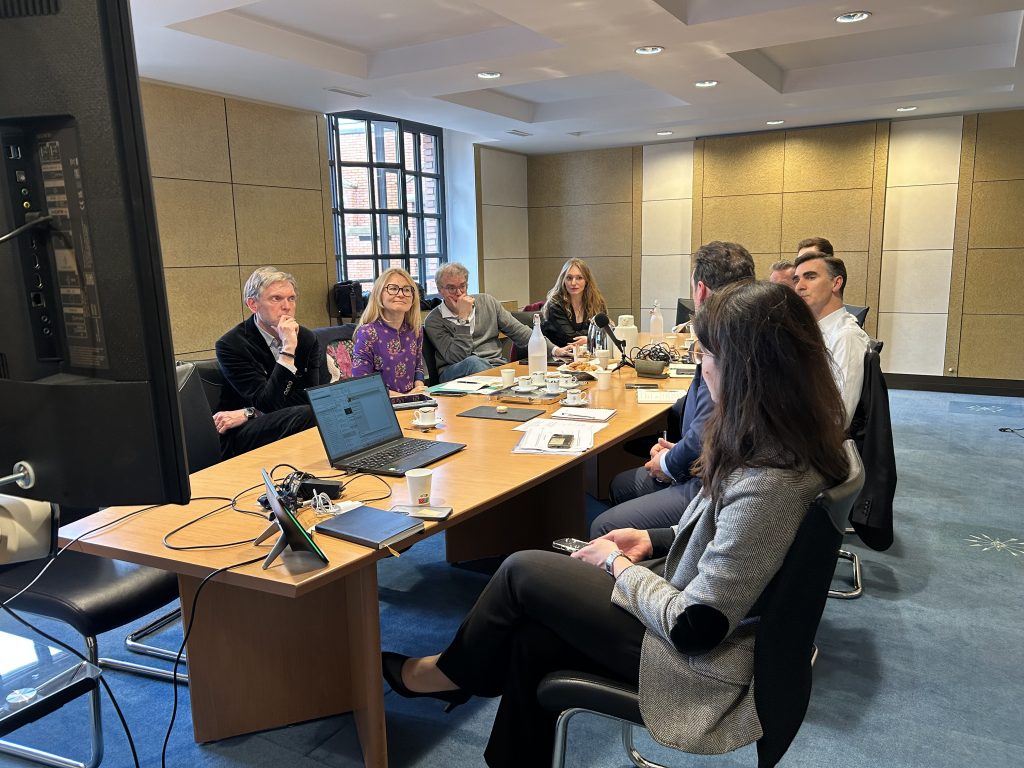
As part of Season 2 of the think tank “2030, Investing for Tomorrow”, the working group “Sovereignty and Sustainability”, co-founded by Edmond de Rothschild Asset Management, met on 10 March 2026 for a second workshop dedicated to European energy sovereignty.
Following an initial session focused on defining the concept of sovereignty, discussions during this second workshop of the working group “Sovereignty and Sustainability: the new European pairing”, co-led by Edmond de Rothschild Asset Management, centred on a concrete question: how can Europe strengthen its energy autonomy without compromising its climate objectives?
A multifaceted concept, between sovereignty and strategic autonomy
From the outset, participants emphasised that energy sovereignty does not have a single agreed definition. “It is a concept that varies depending on the stakeholders and the countries,” noted Thibaud Voïta, energy and climate policy specialist, advisor to the Jacques Delors Institute and co-director of the Master of International Energy Transitions at EM Lyon.
Referring to the definition of Réseau Action Climat, he specified that the concept corresponds to “the ability to implement energy choices that ensure access to energy for all and meet energy policy objectives, at the appropriate scale.”
Beyond this definition, discussions highlighted a multidimensional concept structured around several pillars: political decision-making capacity, security of supply, and industrial and technological control.
However, at the European level, the term itself raises questions. “While the concept of sovereignty does not translate easily, the notion of strategic autonomy is much more widely understood,” said Annabelle Livet, research fellow specialising in energy security at the Foundation for Strategic Research. This semantic nuance reflects deep differences in political and energy cultures across European Union Member States.
In federal countries, energy management operates at multiple levels (federal and regional) and is primarily structured at the municipal level. Energy is often perceived more as a private service than a public one.
Sovereignty put to the test of dependencies
The war in Ukraine and tensions in energy markets have sharply highlighted Europe’s vulnerability. Dependence on imported hydrocarbons remains a major point of weakness, reinforcing the idea that energy sovereignty is a condition for economic and political sovereignty.
However, this dependence extends well beyond fossil fuels. “Dependence is not limited to renewables, it is everywhere,” insisted Thibaud Voïta. Critical materials, technologies and industrial value chains: the energy transition itself is embedded in a system of global interdependencies.
In this context, for Annabelle Livet, “mapping dependencies is no longer the issue—the issue is what we do with them.”
Low-carbon energy at the heart of the equation
In response to these challenges, low-carbon energy sources appear as a key lever for reconciling sovereignty and climate transition. They fulfil three essential functions: reducing dependence on fossil imports, contributing to decarbonisation and stabilising the electricity system.
Nuclear, hydropower and biomass, as dispatchable energy sources, play a key role in maintaining grid balance, alongside intermittent renewables.
In the short term, priorities are clear: securing supply and accelerating investment in renewables, while maintaining existing capacities.
Above all, “investment in renewable equipment enables a longer-term outlook,” emphasised Thibaud Voïta.
However, while policy tools exist to accelerate the transition, their implementation still faces very concrete constraints. “There is already a set of instruments at the European level to support the development of renewable and low-carbon energy,” recalled Annabelle Livet. “But the main bottleneck today lies in energy networks, due to their ageing and connection challenges, particularly in Eastern Europe.”
In this regard, she noted that certain recent incidents, such as the blackout in Spain in April 2025, were primarily due to “grid management issues, rather than renewable energy itself.”
National trajectories fragment Europe
Moreover, Europe cannot rely on a uniform strategy. Energy pathways remain deeply shaped by national histories.
“In Germany, the concept of sovereignty does not resonate,” explained Annabelle Livet. “In federal countries, energy management operates at multiple levels and is primarily built at the municipal level. Energy is often seen more as a private service than a public one.”
Another point of divergence concerns nuclear energy. Between a France historically structured around nuclear power and a Germany committed to phasing it out, differences persist. These reflect political, economic and cultural choices that make it difficult to establish a single model of energy sovereignty at the European level.
Producing, storing and managing: key levers for action
Beyond conceptual debates, discussions identified several concrete levers. The first concerns local production, through the development of renewables, nuclear energy for those countries that choose it, and hydropower capacities.
Dependence on China exacerbates these challenges, highlighting the need to diversify partners.
The second lever relates to storage and flexibility, which have become essential to manage the intermittency of renewable energy and stabilise grids.
Finally, technological and industrial control appears as a necessary condition for sovereignty. “The ability to develop the technologies needed to produce energy ourselves is a determining factor,” said Jean-Christophe Guimard, Managing Partner and Chief Executive Officer of Pearl Infrastructure Capital, particularly in a context where China holds a near-monopoly.
This view is shared by Thibaud Voïta: “our dependence on China worsens the situation; we need to diversify our partners.”
Concrete examples serving sovereignty
To illustrate existing dynamics, Jean-Christophe Guimard presented several concrete examples.
A biomass cogeneration plant in the Vosges relies on 100% local fuel sourced from recycled wood and on European industrial players at every stage of the value chain.
Another example is a French digital platform enabling real-time management of thousands of energy assets. This infrastructure helps restore control over the European electricity system, reduces dependence on gas imports and peak thermal capacity, and facilitates the integration of renewables into the grid.
These examples demonstrate that energy sovereignty cannot be decreed—it is built project by project, at the intersection of industrial, technological and territorial challenges.
Investors as key actors in the transition
In this evolving landscape, investors play a central role. Through their allocation decisions, they help shape energy infrastructure and, by extension, the overall system.
“It is up to us to de-risk, transfer risks and frame them,” said Jean-Francis Dusch, CEO of Edmond de Rothschild AM UK, highlighting the role of financial actors in building resilient infrastructure.
Jean-Christophe Guimard also stressed the need for rational decision-making, “based on industrial and territorial analysis rather than speculative logic.”
A view shared by Jean-Francis Dusch: “We take into account political developments, technologies, as well as security and independence issues, particularly on the debt side,” he explained. “We do not gamble with our investors’ capital—we make informed decisions.”
Sovereignty to be built within interdependence
At the end of the discussions, one idea stood out: European energy sovereignty will neither be total nor uniform. It will have to navigate persistent interdependencies, economic constraints and divergent national trajectories.
A major challenge, commensurate with the climate and geopolitical issues Europe now faces.

