Sovereignty: a concept being reshaped by the pressures of transition
Sovereignty: a concept being reshaped by the pressures of transition
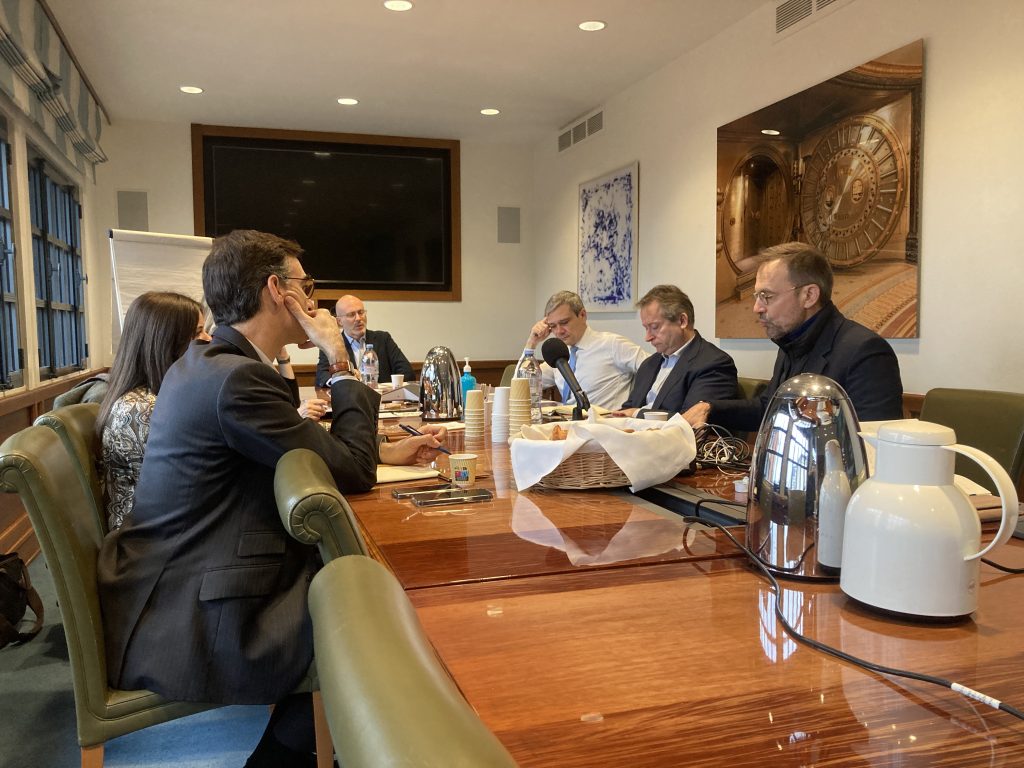
As part of Season 2 of the Think Tank “2030, Investing in Tomorrow,” the working group “Sovereignty and sustainability: the new European pairing,” co-led by Edmond de Rothschild Asset Management, met on 27 November for a first workshop bringing together historical, economic, and operational perspectives on a concept that has returned to the forefront of European public debate: sovereignty.
What is sovereignty? This question framed the opening session, which juxtaposed academic analysis with economic realities to shed light on a notion that has regained prominence across Europe.
Participants first emphasized that sovereignty is not a fixed principle. As explained by Sylvain Kahn, professor of history at Sciences Po and specialist in contemporary European history, sovereignty in its modern sense became firmly established in the twentieth century, when it emerged as a cornerstone of international relations. Its roots, however, go back further, to the political reconfigurations following the wars of religion, when early theories of the modern state were developed.
Sovereignty as a historical and flexible concept
Modern sovereignty rests on three pillars: a territory defined by borders, a population living within that territory, and a public authority governing the whole.
A state is fully sovereign only when the exercise of power does not depend on any other authority. Today, some scholars argue that state sovereignty has, at least in part, been constrained by private actors, notably financial markets.
European history, however, has produced contrasting traditions. France follows a centralized model inspired by the jurist and economist Jean Bodin, while countries such as Germany, Switzerland, Austria, and Belgium developed federal models influenced by the Calvinist thinker Johannes Althusius. In these systems, sovereignty is distributed across different levels of public authority: core sovereign functions lie with the federal state, while federated states retain significant competences.
Over the past forty years, social sciences have shown that sovereignty can be full, partial, or merely nominal. Often, sovereignty is more symbolic than real, even when states sit within international institutions.
Europe as a space of shared sovereignty
Today, sovereignty is being redefined. In public discourse, notably through the speeches of Emmanuel Macron, it has increasingly come to mean autonomy and independence—particularly in economic, industrial, and strategic terms.
The geopolitical context plays a major role. Russia’s invasion of Ukraine significantly altered perceptions in Europe, making the term “sovereignty” more widely accepted. Sovereignty is no longer viewed solely as a legal principle but as an effective capacity closely linked to economic strength.
This aligns with the academic distinction between an internal dimension—exercising power independently—and an external one—being recognized by other states. For Sylvain Kahn, European integration represents not a loss but a reinforcement of sovereignty: a pooling rather than a delegation. “The European Union is us,” he emphasized.
A central question remains: how can European sovereignty be articulated with sustainability challenges? From an academic perspective, there is no structured theoretical link between the two. Sustainability originates from environmental sciences and emerged as a formal concept in the 1990s. Its flexible and widely used nature makes theoretical alignment with sovereignty more complex.
Finance, sovereignty, and sustainability: areas of convergence
From an asset management perspective, sovereignty is approached primarily as an operational matter. Certain European institutional work has been influential, notably the Draghi report commissioned by the European Commission.
As noted by Jean-Philippe Desmartin, Head of Responsible Investment at Edmond de Rothschild Asset Management, this report on European competitiveness highlights structuring themes such as transition, innovation, security, and the financing needs that arise from them.
“Within our funds, there are areas where sovereignty and sustainability intersect, even when the funds are not ESG-labelled. When we talk about innovation, we think about green technologies and energy storage. When we talk about security, we think about energy security, which directly relates to transition issues.”
This view is shared by Anthony Penel, European Equities Portfolio Manager at Edmond de Rothschild Asset Management, who stressed how these considerations translate into concrete investment decisions. Sovereignty appears less as an abstract principle and more as a measurable economic capacity, linked to control over key sectors, robust value chains, and the mobilization of savings.
In this context, sustainability and sovereignty should not be seen as opposing concepts but as parallel responses to shared constraints: external dependencies, geopolitical tensions, and resource scarcity.
A concept in motion
One conclusion stands out: sovereignty is a fluid concept undergoing significant redefinition under the pressure of contemporary crises. While no formal theoretical framework yet links sovereignty and sustainability, the discussions highlighted practical convergences driven by economic, geopolitical, and environmental realities.
This provides a solid basis for further reflection on how European sovereignty can evolve to meet sustainability challenges in concrete terms.

